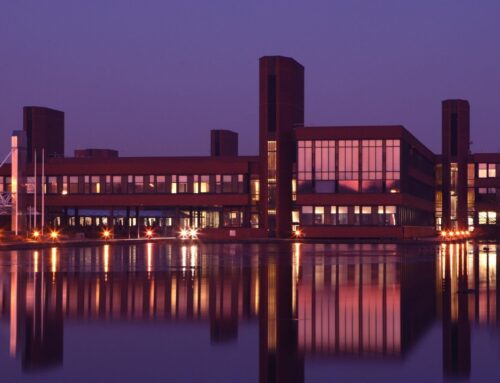
Located near Sittingbourne and nestled in the heart of the Kent countryside, Kent Science Park is the longest-surviving science park in the region, serving as a hub for pioneering breakthroughs across biotech, agritech, biopharma, and related life sciences.
The Park celebrates its 80th anniversary this year, marking eight decades of supporting science and innovation in the UK. In recognition of the milestone, we take a look back at Kent Science Park’s early days and some of the key achievements throughout its history.
Shell Lays Down its Roots
The story of Kent Science Park began just as the Second World War was coming to an end. In March 1945, Technical Products Limited, a subsidiary of Shell, acquired the 332-acre Woodstock Estate for £45,000 (around £2.5m today), with the aim of establishing a trials station for the testing of agricultural chemicals, particularly those used in hop gardens and orchards.
Situated 40 miles from London, the estate included a Georgian mansion, a 400-year-old Grade II listed farmhouse, three cottages, several farm buildings, a walled garden containing many ancient apple and pear trees, and even a maze.
Despite its charm, the farm buildings were partly derelict. Woodstock House was effectively unusable, having been commandeered by the War Office as a hospital, plus there was no mains electricity, and the local War Agricultural Committee had downgraded the land to Category C.
However, Shell recognised the untapped potential in the rural site and had a vision of transforming it into a global research centre. What began as a ‘trials station for temperate crops’ soon evolved into a centre of excellence in a wide range of scientific disciplines. Innovative research performed here led to the control of malarial mosquitos and locusts, saving countless lives.
By 1955, there were over 100 Shell staff working on the site, and construction of a canteen and new laboratories began. These labs were officially opened in 1956 by Sir William Slater, Secretary of the Agricultural Research Council. A plaque was installed, which is still at the site today, and Sir William’s agricultural skills were put to the test when he planted a Catalpa tree to commemorate the event. He passed this test – the tree still stands tall outside Building 190 today.
At this point, the site – which became known as Woodstock Agricultural Research Centre – had 25,000 sq ft of laboratory space and 4,600 sq ft of glasshouses. The glasshouses housed a range of equipment, including an artificial rainmaker and dazzling artificial lighting, with which scientists could replicate temperatures and humidities from every part of the world.
A Nobel Legacy
Nearly two decades after acquiring the site, Shell established the Milstead Laboratory of Chemical Enzymology in 1963, under the leadership of Lord Victor Rothschild. This pioneering initiative brought together a team of 12 scientists who went on to make groundbreaking contributions to biochemical research.
Among them was Sir John Cornforth, who, alongside co-director George Popják, undertook seminal research into the biosynthesis of cholesterol in living tissues. Their discoveries were instrumental in the development of molecules that reduce the body’s natural production of cholesterol, ultimately laying the scientific foundations for statins, the cholesterol-lowering drugs now used globally to prevent cardiovascular disease.
Sir John went on to become one of the most distinguished chemists of his generation. Alongside his wife and scientific collaborator, Lady Rita Cornforth, who was a formidable chemist in her own right, he co-authored over 40 scientific publications. Their work at Milstead led to significant advances in the understanding of enzyme-catalysed reactions, culminating in Sir John being awarded the Nobel Prize in Chemistry in 1975.
Today, a commemorative plaque at Kent Science Park honours his pioneering legacy; it is a lasting tribute to the transformative research carried out at Milstead and an enduring inspiration to future generations of scientists working at the Park.
A Great Place to Work
The true story of Kent Science Park is written by the scientists, technicians, and innovators who have worked behind its doors.
In the same year Sir John Cornforth was awarded the Nobel Prize in Chemistry, a burgeoning lab technician came across a job advert in the New Scientist for a position within Shell’s agricultural research team. That scientist, Dr David Potter, successfully applied, and unknowingly set the course for a remarkable 50-year career at Kent Science Park.
Looking back at those early years, David reflects that the site felt like a university campus. He explains: “Easily accessible from the city yet immersed in nature, the Park was truly a model of what a workplace should look like, and I was fortunate to fall in with a lovely team of people right from the get-go. It was immediately a great place to work. The site was beautiful, well-equipped, and always buzzing with activity. People loved working there, and as his best man, I even attended my best mate and colleague John’s wedding reception there.
“We appreciate mindfulness more and more these days – at the Park, there are so many places you can go if you want a quiet moment, and lots of secret gardens when you can sit, take a break and ponder over things.”
David began his career in glasshouse research during the summer of 1976, a year remembered both for its record-breaking heat and the subsequent drought across the UK. Due to the extreme temperatures inside the glasshouses, researchers were required to work strict 30-minute shifts to cope with the conditions.
Reflecting on the early years of his career, David recalls a strong emphasis on developing new facilities across the site, and he was often moving into new, modern buildings as soon as they were commissioned. As time went on, the glasshouses also became increasingly advanced in both design and technology.
The 1980s saw the construction of 760 glasshouse, where David would go on to spend the second half of his 50-year career at Kent Science Park. He says: “Amongst the new innovations in the 1980s was so-called ‘clonal forestry’; genetically modified hybrid trees would be bred and cloned and thousands of acres of commercial plantations established across the world. There are three enormous eucalyptus trees outside the 760 glasshouse, which arose from that research.”
A Period of Change
In 1990, it was announced the agricultural research conducted at the Park would be reduced, then by 1993, the department totally ceased following the sale of Shell’s agrochemical business.
David initially faced redundancy but successfully transitioned into an estates management role at the Park as Head of Security. In this position, he played a pivotal role in enhancing site security, establishing strong relationships with local police and regularly liaising with Special Branch, as well as with counterparts at other research centres across Europe. These efforts were aimed at protecting the confidentiality of the work carried out at the Park and would later prove valuable when David returned to laboratory research in the next phase of his career.
Sadly, Shell ultimately stepped away from the site in the mid-1990s as part of a strategic decision to focus on its core business. This closure resulted in the loss of several hundred jobs, including David’s, and ushered in a period of uncertainty for the Park.
However, the end of one era marked the beginning of another. As Shell scaled back its R&D activities, the site was reimagined as a vibrant hub for early-stage, innovative life science companies working at the forefront of emerging scientific and healthcare technologies.
Life-changing Pharmaceuticals
Returning to both Kent Science Park’s glasshouses and laboratory research, David joined GW Pharmaceuticals as its very first employee in 1998. He went on to become Director of Botanical Research and Cultivation, playing a key role in the company’s early success developing medical cannabis treatments within the 760 glasshouse.
GW Pharmaceuticals began as a start-up and quickly grew into a publicly listed company, its success underpinned by the secure and professional facilities at Kent Science Park, which David had previously helped to lay the foundations for. The company’s flagship medicine, Epidiolex® (cannabidiol) oral solution, is approved for use in patients to treat seizures associated with rare and severe forms of early-onset epilepsy.
David says: “We sowed our first seeds on 24 August 1998 and in the years that followed, two cannabis-derived prescription medicines were developed. One small step for horticulture was a giant leap for pharmacy. In 2021, Jazz Pharmaceuticals bought our company for $7 billion. It was one of the greatest success stories of the biotechnology industry.”
Recent Scientific Milestones
Over the past eight decades, Kent Science Park has been home to a remarkable array of pioneering research, quietly underpinning advances that have gone on to change lives around the world. From breakthrough diagnostics to agricultural biotech, a number of transformative ventures have recently taken root at Kent Science Park:
PlantWorks
Elsewhere on the site, PlantWorks, a spin-out from the International Institute of Biotechnology, established itself as the UK’s sole mass producer of Arbuscular Mycorrhizal Fungi (AMF). With an annual output exceeding 150 tonnes, the fungi are used in the company’s Empathy product range, now a staple in garden centres across the country, supporting sustainable agriculture from the ground up.
ToxiMet
Food safety also saw a significant advancement thanks to ToxiMet, which developed a highly sensitive device – ToxiQuant – capable of detecting dangerous mycotoxins in food down to parts per billion. This technology is now deployed globally, helping to ensure that what ends up on our plates is safe to eat.
AbBaltis
Testament to the Park’s enduring appeal, AbBaltis, an innovative, in vitro diagnostics research company, chose to return to Kent Science Park in 2025 after initially being based there from 2011 to 2019. This decision reflects the site’s continued status as the place to be for high-growth biotech enterprises.
Immundnz
Another innovator based at the Park is Immundnz, an immunology CRO. With customised services and in-depth knowledge in immune mechanisms and protein biology, the company provides solutions needed to make better decisions in drug discovery at the non-clinical and pre-clinical stage.
Kent Science Park: Designed to Inspire
In 2016, real estate investors Angelo Gordon purchased the site in a joint venture with UK property company Trinity Investment Management. Pioneer Group then proudly took over the reins as operators of the Park in 2021.
Kent Science Park now offers over 47 buildings of labs, offices, and co-working spaces, set within 65 acres of manicured parkland. The iconic Woodstock House even accommodates a charming on-site nursery.
The Park is also home to some visionary architecture; one building’s winding staircase was famously designed to reflect the DNA helix, a nod to the park’s deep-rooted scientific identity.
Today, Kent Science Park continues to expand, with planning permission granted for over 120,000 sq ft of new development.
Whether it’s developing life-saving medicines, sustainable agriculture, or molecular biology, Kent Science Park remains dedicated to nurturing the next generation of scientists and cultivating scientific breakthroughs, 80 years down the line.

Explore Kent Science Park
Be a part of the site’s next chapter.